Know Your Options for an Exit
There are many routes for a successful business exit. Whether it’s selling to someone you know, a family member, or taking the business out to market for an unknown 3rd party buyer, all require preparation and planning.
If taking the business to the open market is the best route for you, here’s a few key details.
Multiple offers
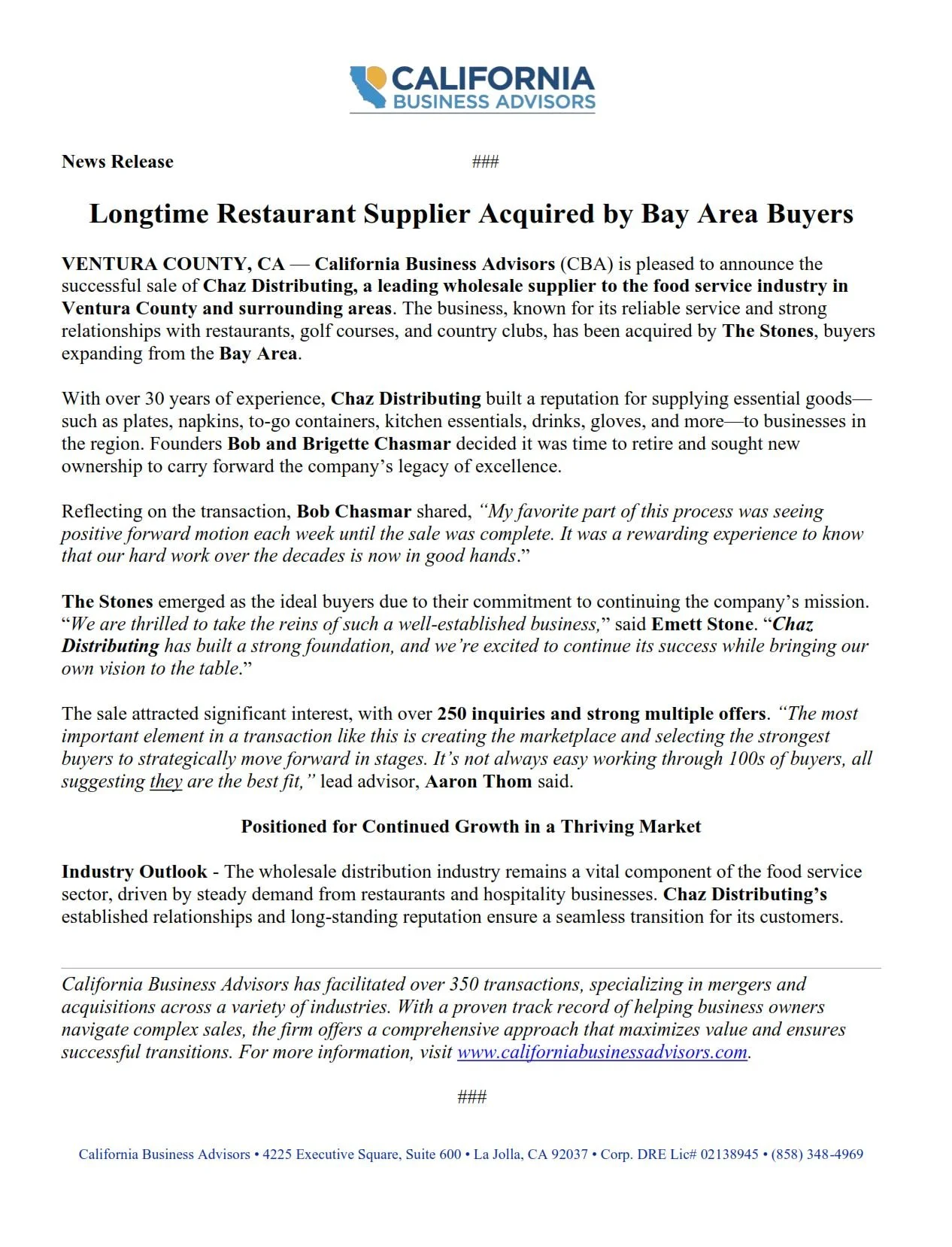
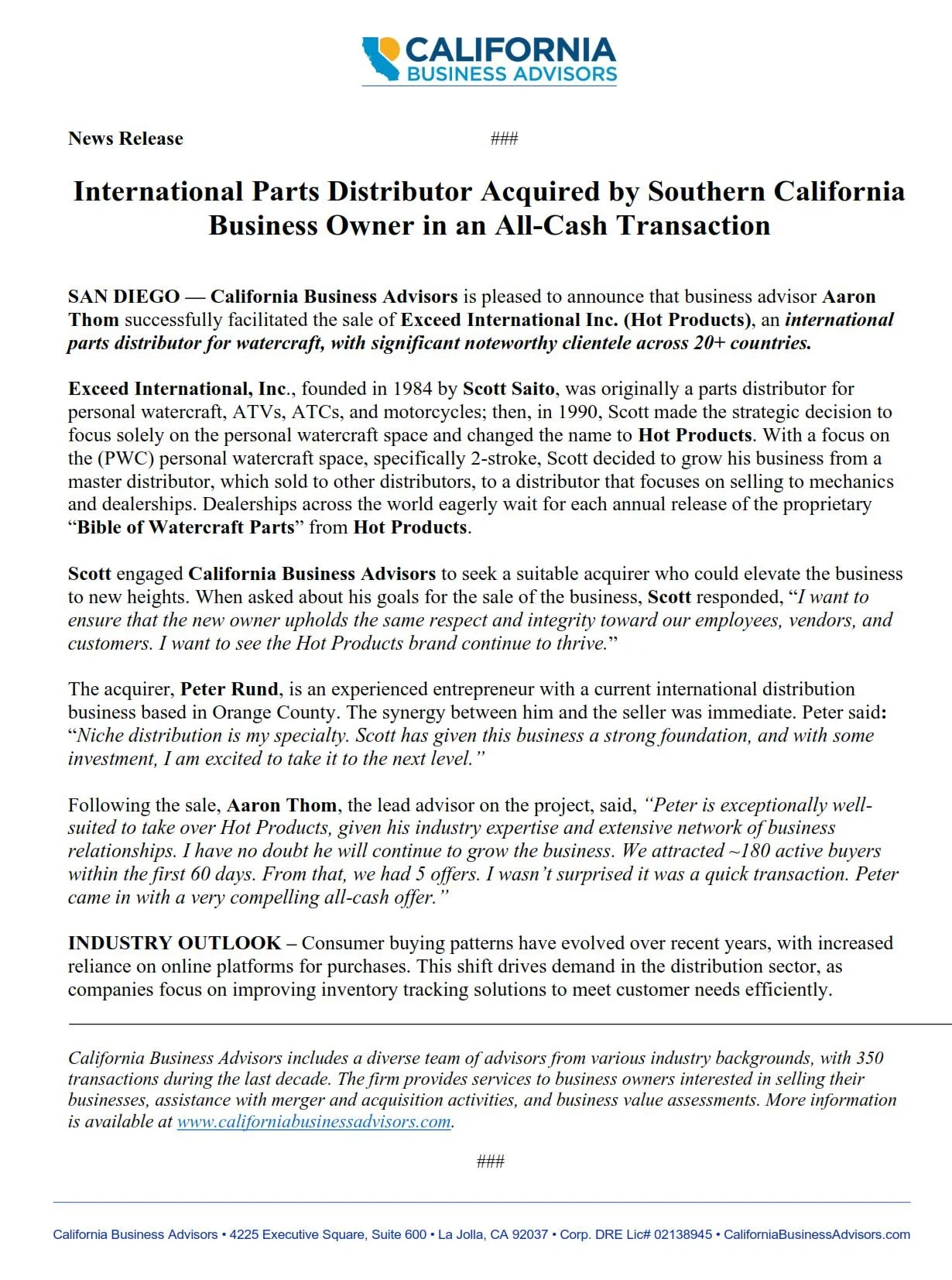
Our last 4 years of projects have received multiple offers AT-OR-ABOVE asking price. See our recent sales here
Buyer demand is STRONG
Across all industries, businesses in Southern California remains strong. CBA maintains a database of 10,000+ qualified buyers actively looking for acquisition opportunities
Many businesses are SELLING AT A PREMIUM
Most sale-side projects receive 200+ buyers - driving up prices and valuation
Other MACRO points to consider when selling your business:
Inflation and interest rates will affect the value of your business
A drastic change in the stock market or economy will affect your value
A future political change could affect your business value
We often meet with business owners years in advance
The team at CBA will meet with business owners years in advance - helping identify blind spots in the top ten areas of business value - including the financials (profitability, gross profit, and net income ratios).
Our initial meeting is one hour, preferably at one of our offices in Southern CA - though we’re willing to facilitate via Zoom, if needed. We’ll review the overall sale process, what makes us unique at CBA compared to anyone else in our industry, and cover some basics on business valuation processes. Review the CBA Sale Advantage+ here.
There’s never been a better time to consider going to market.
Find Out What Your Business is Worth. The best business owners have a good idea of what their business is worth. We offer a complimentary and confidential value analysis. We only ask for the last three years of profit-and-loss statements to do the review. It takes only a few days.
Your business may be more valuable than you think. Qualified buyers are actively looking, SBA financing remains available, and CBA's last four years of engagements have each received multiple offers at or above asking price. The window to exit at a strong valuation is open — but preparation determines how much you walk away with
Call Us Today at 858-348-4969
-
Most businesses take six to twelve months from the time they go to market to the day of closing. The preparation phase before going to market -- organizing financials, drafting the confidential information memorandum, and running the Predictive Market Analysis -- typically takes two to four weeks on top of that. Deals move faster when the financials are clean and the owner is prepared for due diligence. Deals slow down when buyers find surprises. The single biggest thing a seller can do to shorten the timeline is to have three years of accurate profit and loss statements ready before the process begins.
-
Most businesses in the lower middle market sell for a multiple of Seller Discretionary Earnings (SDE) -- the total financial benefit the owner receives from the business annually, including salary, profit, and owner perks. The multiple depends on the industry, how dependent the business is on the owner, the stability of revenues, and the quality of the team. CBA offers a complimentary and confidential value analysis -- all we need are your last three years of profit and loss statements to give you a realistic range.
-
Confidentiality is one of the most important parts of a well-run sale process, and it is something CBA manages carefully. Buyers sign a Non-Disclosure Agreement and a personal financial statement before receiving any information about the business. The business is marketed without its name, address, or any identifying details. Employees, customers, and suppliers are not notified the transaction has been finalized. The goal is for your team to learn about the sale from you, on your terms, not through the rumor mill.
-
An M&A advisor manages the process of selling your business from start to finish. That includes valuing the business, preparing the marketing materials, identifying and qualifying buyers, managing confidentiality, negotiating offers, and coordinating with attorneys, accountants, and lenders through due diligence and closing. Think of it as having a transaction team in your corner -- one that has done this hundreds of times and knows where deals fall apart before they do. Most business owners sell once in their life. A good advisor has seen every scenario and knows how to keep a deal moving.
-
Business brokers work on a success fee -- meaning there is no upfront cost and no fee unless the business sells. The commission is typically a percentage of the total sale price, paid at closing. CBA will walk you through the fee structure in your first meeting. Because brokers are paid on results, their incentive is fully aligned with getting you the highest price possible.
-
The core documents buyers and lenders will require are three years of profit and loss statements, three years of business tax returns, a current balance sheet, and a list of equipment and assets included in the sale. Depending on the industry, you may also need copies of key contracts, lease agreements, licenses, and employee agreements. CBA will walk you through exactly what is needed for your specific business during the preparation phase. The more organized your records, the smoother due diligence goes -- and the less leverage buyers have to renegotiate price.
-
Seller financing means you, the seller, agree to carry a portion of the purchase price as a loan to the buyer -- typically paid back over three to seven years with interest. It is common in lower middle market deals and often expected by buyers and lenders. SBA loans frequently require the seller to carry 10% of the purchase price on standby. Offering seller financing can actually increase your sale price and attract more qualified buyers because it signals confidence in the business's continued performance. CBA will advise you on what is standard for your industry and deal size so you are not leaving money on the table or taking on unnecessary risk.
-
The right time to sell is when three things align: your business is performing well, you are personally ready to transition, and you have given yourself enough time to prepare properly. Trying to sell a business that is declining is harder and produces lower prices. Waiting too long -- past your peak energy or past the business's peak performance -- costs sellers real money. The owners who get the best outcomes are the ones who start the conversation one to two years before they actually want to close. CBA meets with business owners years in advance at no cost, with no obligation, specifically to help you think through timing and identify anything that could be improved before going to market.